Modulate
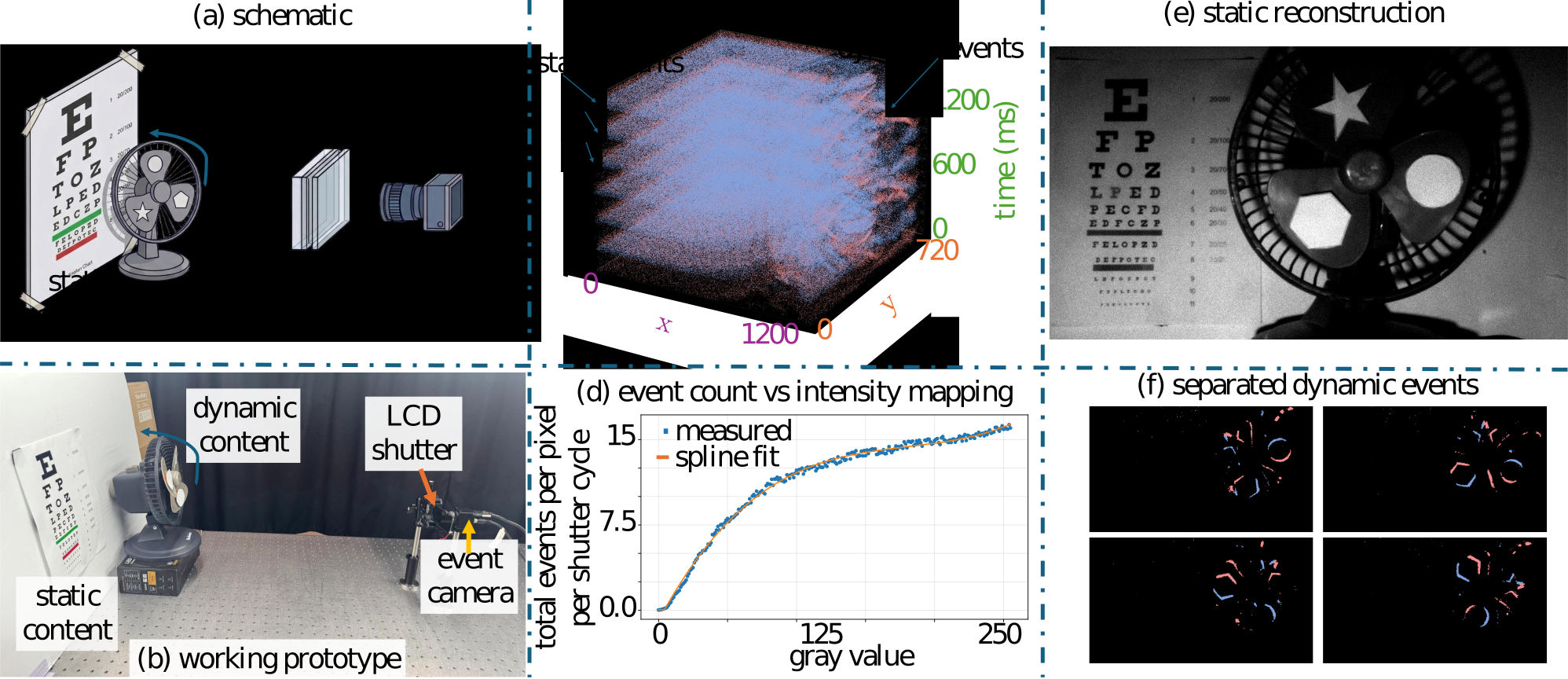
A low-cost LCD shutter converts otherwise invisible static intensity into temporally structured event activity.
IEEE ICCP 2026
Learning free reconstruction of static and dynamic scenes using Event Cameras.
1Rendering and Imaging Science Lab, Dartmouth College 2Intelligent Sensing Lab, University of Maryland * Equal contribution
Method at a glance
ShutterEvents modulates the light incident on the event camera, using a low-cost LCD shutter and uses the resulting event statistics to reconstruct both static and dynamic scenes.
A low-cost LCD shutter converts otherwise invisible static intensity into temporally structured event activity.
Shutter modulation creates a monotonic relationship between event counts and intensity, enabling scene reconstruction without the need for a learned prior.
Preserve the dynamic sensing capabilities of the event camera by suppressing the shutter frequencies in the modulated event signal to separate static and dynamic components.
Paper
Event cameras capture changes in log intensity asynchronously, enabling high temporal resolution and dynamic range for dynamic scenes. However, because they respond only to intensity changes, they are fundamentally insensitive to static or slowly varying content, leading existing event-to-video methods to rely on camera motion or hallucinate missing structure. Prior efforts to recover static information either exploit Poisson noise events - requiring long integration times - or employ mechanical shutters to convert event cameras into intensity sensors, sacrificing temporal resolution.
We introduce ShutterEvents, a lightweight sensing framework that enables simultaneous recovery of static and dynamic scene content using a low-cost ($7) programmable LCD shutter. By imposing controlled temporal modulation on incoming light, static intensities are transformed into predictable brightness variations that generate informative events even under a stationary camera. We show that the induced mapping between event statistics and scene intensity is injective, enabling a learning-free reconstruction of static structure directly from event measurements.
To separate shutter-induced responses from true scene dynamics, we propose an event decomposition algorithm that leverages the global temporal synchronization introduced by the modulation signal. Experiments on both simulated and real data demonstrate that ShutterEvents recovers meaningful static structure while preserving dynamic fidelity, without long integration times and with minimal hardware overhead.
Cite this work
@inproceedings{batagoda2026shutterevents,
  title     = {ShutterEvents: Shutter Modulation for Static-Dynamic Scene Recovery},
  author    = {Batagoda, Nevindu M. and Bhaskara, Ramchander Rao and Metzler, Christopher and Pediredla, Adithya},
  booktitle = {2026 IEEE International Conference on Computational Photography (ICCP)},
  year      = {2026},
  url       = {https://nevindu.github.io/publications/shutterevents/}
}